Epispadias
Epispadias represents a congenital anomaly which is characterized by short phallus with marked upward curvature (dorsal chordee). The problem can also include the bladder and large intestine. The degree of affecting genitalia in epispadias varies. For instance, in boys it can be just a small dimple on the tip of the penis above the normal opening. With girls it could be a double clitoris. If the urethra or bladder are involved, the epispadias are usually more severe and this large spectrum of malformations is called the exstrophy-epispadias complex. (see epispadias-exstrophy) Epispadias rarely occur as an isolated defect.
Epispadias is quite rare, with only one in 117000 males being affected. In affected boys, the penis is typically broad, shortened and curved toward the abdomen (dorsal chordee). The penis is attached to the pelvic bones, which are widely separated, resulting in a penis that is pulled back toward the body. Classification of epispadias is based on the location of the urethral meatus. It can be positioned on the glans (glanular), along the shaft of the penis (penile) or near the pubic bone (penopubic). The position of the meatus is very important, predicting the capacity of the bladder to store urine (continence). The closer the meatus is to the top base of the penis, the more likely the bladder will not hold urine.
In most cases of penopubic epispadias, the bones of the pelvis do not come together in the front. In this situation, the bladder neck cannot close completely and the result is leakage of urine. Most boys with penopubic epispadias and approximately two-thirds of those with penile epispadias have leakage of urine with stress (e.g., coughing and strenuous effort). Ultimately, they may require reconstructive surgery of the bladder neck. Almost all of the boys with glanular epispadias have a good bladder neck. They can hold urine and toilet train normally. However, the penis abnormality (upward bend and abnormal opening) still requires surgical repair.
The diagnosis of epispadias is typically made at birth. Although, on occasion when the malformation may not be drastic, epispadias has been missed at birth and only becomes apparent when the child (usually female) remains wet after toilet training.
Associated problems
Patients with epispadias have a low incidence of abnormalities that affect organ systems other than the genitourinary system and the pelvic bones. Therefore, these children do not require extensive diagnostic radiographic studies. On the other hand, babies born with the more severe form of exstrophy-epispadias complex are at a slightly increased risk for the existence of associated malformations like enlarged ureter or vesicoureteral reflux. The standard of care for these children is antibiotics therapy until the reflux is corrected.
Boys with penopubic epispadias or the exstrophy-epispadias complex have specific genitourinary anatomy that may make them infertile. In men with penopubic epispadias or the exstrophy-epispadias complex, the bladder neck may not close completely during ejaculation. This allows the sperm to move backwards into the bladder (retrograde ejaculation). Some patients may have poor sperm quality. Furthermore, dorsal chordee and a short, stubby penis may make sexual intercourse difficult. However, improvements in surgical repair have significantly reduced the severity of these problems.
Treatment
The primary goals of treatment of epispadias are to: lengthen and straighten the penis by correcting dorsal bend and chordee; and create functionality and cosmetically acceptable external genitalia with as few surgical procedures as possible. If the bladder and bladder neck are also involved, surgical treatment is required to establish urinary continence and preserve fertility.
There are two popular surgical techniques that achieve these objectives. The first is the modified Cantwell technique, which involves partial disassembly of the penis and placement of the urethra in a more normal position. The second technique and most recent evolution of the modern epispadias repair is the complete disassembly of the penis into its separate components – two corpora cavernosa and a single corpus spongiosum. Following disassembly, the three components are reassembled such that the urethra is in the most functional and normal position and dorsal chordee is corrected. Both techniques provide a straight urethra positioned on the underside of the penis, correction of chordee and an acceptable cosmetic result. The disassebmbly technique has a lower complication rate and facilitates bladder and bladder neck repair. Sometimes, boys with the exstrophy-epispadias complex are born with a very small or severely underdeveloped penis. In these situations, surgical reconstruction of the penis is more difficult, and sometimes reserved for total phalloplasty.
Children with the exstrophy-epispadias complex may require surgery to improve the urethral resistance (bladder neck repair). However, the new methods of primary repair at birth allow almost one third of the patients to achieve urinary control without the need for other procedures.
Female epispadias
Epispadias is much more rare in girls, with only one of 565000 affected. Those who are affected have pubic bones that are separated to varying degrees. This causes the clitoris not to fuse during development, resulting in two halves of the clitoris. Furthermore, the bladder neck is almost always affected. As a consequence, girls with epispadias invariably leak urine with stress (e.g., coughing and strenuous effort). Fortunately, in most cases, early surgical treatment can resolve these problems.
Genital reconstruction in girls with bladder exstrophy is less complex compared to the reconstruction in boys. The urethra and vagina may be short and near the front of the body and the clitoris is in two parts. The internal female structures – uterus, fallopian tubes and ovaries – are normal. If diagnosed at birth, the two parts of the clitoris can be brought together and the urethra can be placed into the normal position. If repaired early enough, lack of urinary control (incontinence) may not be a problem. If the diagnosis is missed or if early repair is not performed, then incontinence can be surgically corrected at the time of diagnosis. If the vaginal opening is narrow in older girls or younger women, reconstruction can be performed after puberty. Females with epispadias usually are not at risk for infertility since their internal reproductive organs are normal.
CASE 1
Epispadias repair

Normal appearance of the penis

After foreskin retraction epispadias with dorsal penile curvature is visible
.jpg)
Outcome after total reconstruction of penis and urethra
_001.jpg)
Outcome after total reconstruction of penis and urethra
CASE 2
Epispadias repair in childhood

Appearance of the penis – ventral view

Appearance of the penis – lateral view

Epispadiac glans with dorsal curvature is visible after foreskin retraction

Result after complete reconstruction of the penis and urethra

Result after complete reconstruction of the penis and urethra
CASE 3
Epispadias repair – second stage

Preoperative appearance. Penile straightening and lengthening was previously done in first stage repair, urethrostomy was left for later closure.

Correction of all penile deformities was performed during first stage.

Outcome after second stage urethroplasty and penile skin reconstruction.
CASE 4
Failed epispadias

Appearance after several failed surgeries
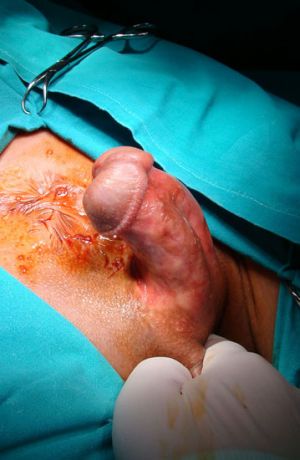
Appearance after several failed surgeries
_was_left_for_later_closure.jpg)
Outcome after radical penile reconstruction
CASE 5
Failed epispadias

Appearance after failed repair in childhood. Urethra is missing.

Appearance after failed repair in childhood. Urethra is missing

Outcome after penile reconstruction

Outcome after penile reconstruction

Second stage urethroplasty: buccal mucosa graft and scrotal skin flap

Second stage urethroplasty: buccal mucosa graft and scrotal skin flap.
CASE 6
Failed epispadias in adult

Appearance after multiple failed surgeries. Penile shaft and urethra are missing.

Penile disassembly – both corpora cavernosa are completely separated from the glans cap with neurovascular bundle and from the short urethra.

Appearance of the penis after reassembly. Penis is lengthened. Urethra is placed at the base of the penis, for the second stage reconstruction.
1. Djordjevic M, Kojovic V, Bizic M, Majstorovic M, Vukadinovic V, Korac G, Krstic Z. Epispadias repair after failed surgery in childhood. Eur J Pediatr Surg. 2013 Feb;23(1):67-71.
2. Djordjevic ML, Bizic MR, Martins F, Kojovic V, Krstic Z. Treatment for failed epispadias repair presenting in adults. J Urol. 2013;190:165-70.
3. Kojovic V, Majstorovic M, Bizic M, Djordjevic M. Radical approach in epispadias redo surgery in adulthood. European Urology Supplements 2010 9 (6):573-573.
4. Djordjevic ML, Bumbasirevic MZ, Vukovic PM, Sansalone S, Perovic SV. Musculocutaneous latissimus dorsi free transfer flap for total phalloplasty in children. J Pediatr Urol, 2006; 2(4): 333-339.
5. Djordjevic M, Perovic S, Vukadinovic V. Surgical anatomy of epispadias and its impact on surgical treatment. Urology, 2006; 68(suppl.5):18(abs.PD05.08)
6. Perovic S, Djordjevic M, Vukadinovic V. Real complete disassembly – lengthening procedure for epispadiac penis. BJU Int., 2004; 94(suppl.2):116(abs.117.10)
7. Perovic S, Djordjevic M, Djakovic N. Epispadiekorrektur:ein komplexer casus. Der Urologe, 2004; 43(suppl. 1): 109(abs. 2.5).
8. Perovic S, Djordjevic M, Kekic Z, Vukadinovic V. Detrusorectomy with rectus muscle hitch and backing. J Pediatr Surg, 2003; 38(11):1637-1641.
9. Perovic S, Djordjevic M, Djakovic N. Complete disassembly technique in epispadias repair: a new variant. Eur Urol, 2000; 37(suppl 2): 164.
10. Perovic S, Djordjevic M, Djakovic N. Komplette disassembly technik bei der epispadiekorrektur-eine neue variante. In Urologie Trends and Perspektiven, Jonas, U. and Machtens, S.A. (eds.), Biermann Verlag GmbH, Koeln, 2000, 140-144.
11. Djordjevic M, Perovic S, Djakovic N. Penile disassembly technique in epispadias repair: our variant. Br J Urol, 2000; 86(suppl.3):216.